Why Choose Warehouse Floor Epoxy Coating In Wilmington?
Quick Summary
Warehouse floor epoxy coating offers a familiar, budget-friendly option for Wilmington facilities, but salt air, high humidity, and hurricane-driven flooding expose weaknesses in epoxy that show up within a few years of installation. Polyaspartic polyurea bonds into the concrete rather than sitting on top of it, resists moisture and chemical exposure better than epoxy, and cures in a single day instead of several.
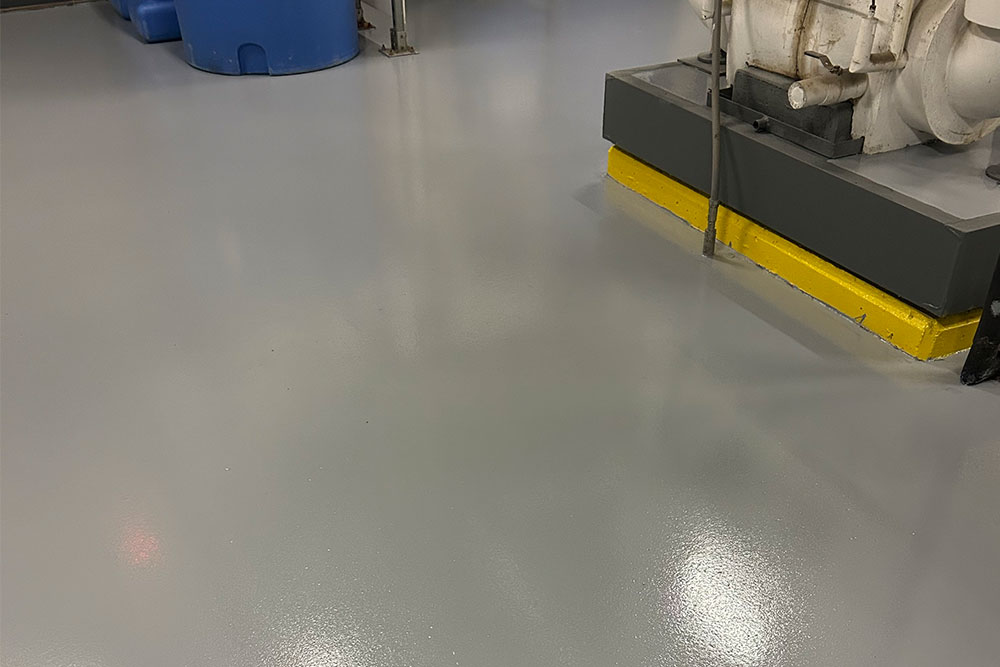
Warehouse floor epoxy coating shows up on almost every shortlist when a Wilmington facility manager first starts looking into flooring options, and it’s easy to see why. Epoxy has a long track record, a lower price tag than some alternatives, and enough chemical resistance to handle typical warehouse traffic.
Wilmington’s coastal location changes that equation, though, since salt air, high humidity, and hurricane season put pressure on a floor that epoxy wasn’t built to handle over the long run. A warehouse floor coating built for coastal conditions is worth comparing before committing to epoxy by default.
Why Epoxy Is a Common Choice for Wilmington Warehouses
Epoxy earned its reputation for good reason. It’s widely available, installers know the product well across the industry, and the upfront cost tends to run lower than premium alternatives.
For a dry, climate-controlled warehouse with light to moderate traffic, epoxy can hold up reasonably well for a few years and gives a glossy, finished look that reads as clean and professional to visitors, inspectors, and clients touring the facility.
Where Epoxy Falls Short in a Coastal Climate Like Wilmington’s
New Hanover County sits on sandy coastal soil with a high water table, and that combination pushes moisture up through a concrete slab more than most inland locations ever deal with. Epoxy forms a rigid film on top of the concrete. When trapped moisture pushes against that film from below, it bubbles, peels, or delaminates in patches rather than failing evenly across the surface.
Salt-laden air near the coast adds to the wear on any coating exposed to loading dock doors that stay open through the day. Wilmington’s hurricane exposure raises the stakes further, since storms like Florence pushed serious flooding through the area in recent years, and a warehouse floor needs to handle that kind of moisture event without falling apart in the months that follow.
On top of the durability concerns, epoxy typically needs several days to cure before a floor can handle full equipment traffic again, which adds up to real downtime for a working facility that can’t afford to sit idle.
Why Polyaspartic Polyurea Outperforms Epoxy for Wilmington Warehouses
A proprietary polyaspartic polyurea coating bonds into the surface of the concrete itself instead of resting on top of it, which removes the trapped-moisture problem that causes epoxy to bubble and peel near the coast. The material stays flexible under the weight and vibration of forklifts and pallet jacks, resisting the cracking that catches up with a rigid epoxy film after repeated impact in the same traffic lanes over time.
Installation typically finishes in a single day, with the floor ready for full equipment use the next day instead of the multi-day wait epoxy requires before a warehouse can get back to normal operations.
Guardian backs every finished floor with a transferable lifetime warranty, a level of coverage standard epoxy products don’t come close to matching. The coating’s resistance to salt and humidity holds up through hurricane season year after year without needing constant touch-ups.
Let Guardian Garage Floors Coat Your Wilmington Warehouse
We work with warehouses, distribution centers, and port-adjacent facilities across Wilmington, and coastal conditions factor into every recommendation we make for a client. Our full-time, trained installers handle every project themselves, no subcontractors.
A free flooring estimate starts with an on-site visit to test the slab and outline a schedule that works around your operation instead of the other way around. Ready for a floor built for salt air, humidity, and hurricane season instead of just a showroom-ready look? Request a quote today.
FAQs
Does epoxy hold up well in humid, coastal warehouses?
Epoxy can perform fine for a few years in a dry, climate-controlled space, but trapped moisture pushing up through the slab near the coast often causes bubbling or peeling sooner than it would in an inland location.
How does polyaspartic polyurea handle salt air exposure?
The coating resists the corrosive effects of salt-laden air better than epoxy, since it bonds into the concrete rather than forming a separate surface layer that salt exposure can degrade and weaken over time.
How long does a warehouse floor coating take to install?
Most warehouse floors finish in a single day, from grinding through the final seal coat, with the space ready for full equipment traffic within 24 hours of completion, well ahead of what epoxy typically requires.